Personal Closed beta
Rasante
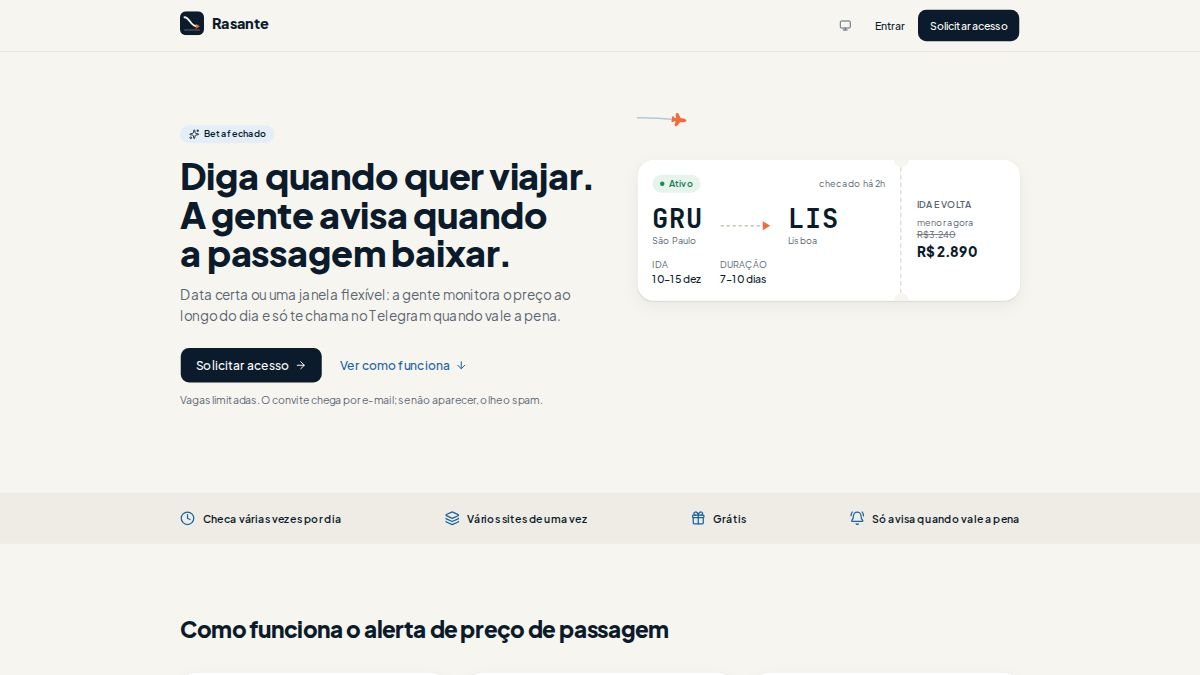
Flight price alerts for people with flexible dates. You set the window you can travel in, Rasante tracks every date and sends a Telegram message when the price drops.
The code is closed source, so this page covers the decisions, not the code.
Problem
When you can travel on any day within a window, the cheapest flight can be on any of those dates, and the price of each one changes every day. Finding the best one means searching date by date, again and again.
The spread is large. In a test search from Viracopos to Juazeiro do Norte with 12 possible departure dates, the cheapest date cost R$ 509 and the most expensive R$ 1,887.
Rasante started as a script I wrote to follow prices for a trip to Punta Cana. I bought when the price dropped to the average I had been watching. Knowing the price was good mattered more than finding the lowest one ever.
What I built
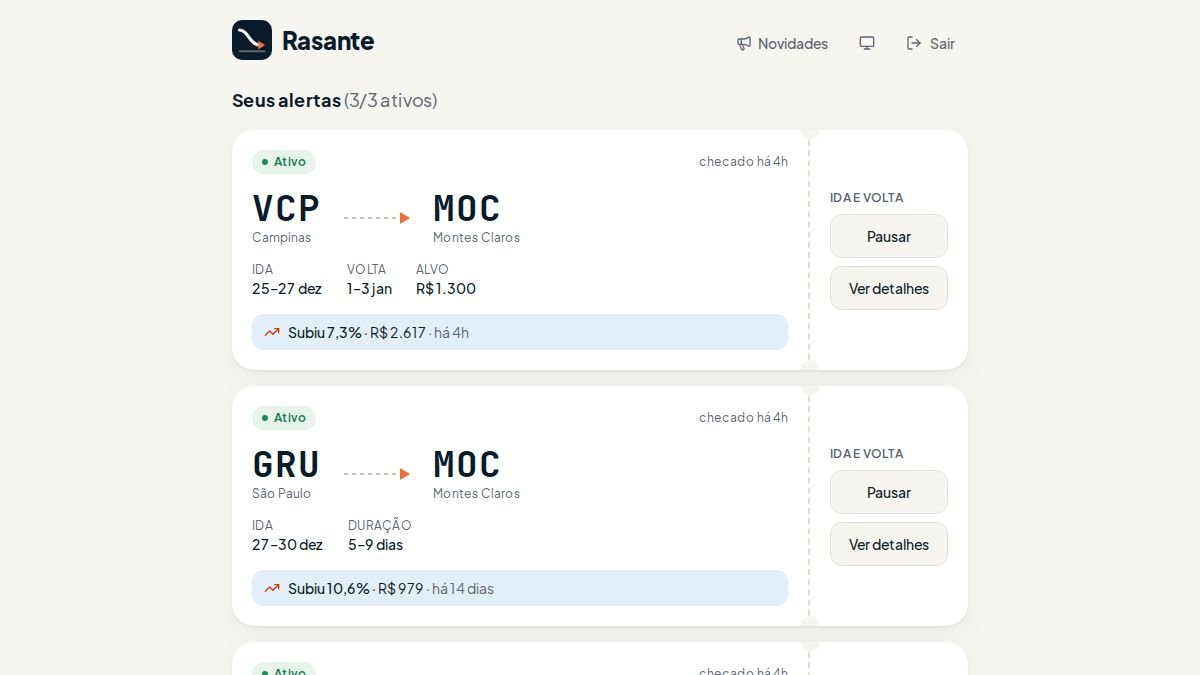
A website where people create an alert (route, date window, trip length and, optionally, a target price) and a Telegram bot that delivers the alerts. Several times a day, a scheduled job checks every date in the window across more than one source, stores the history and decides whether it is worth sending an alert.
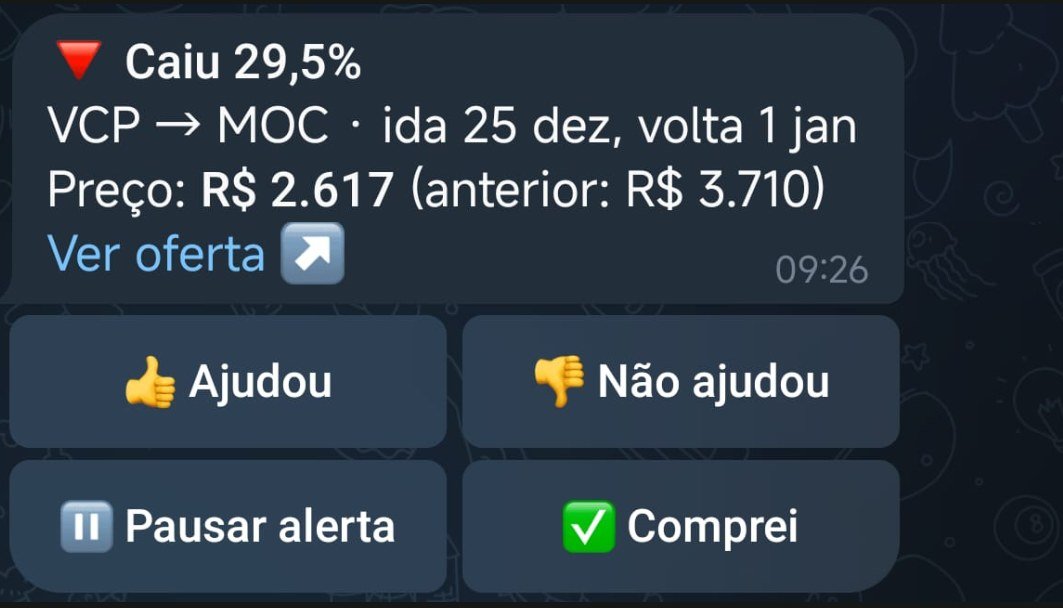
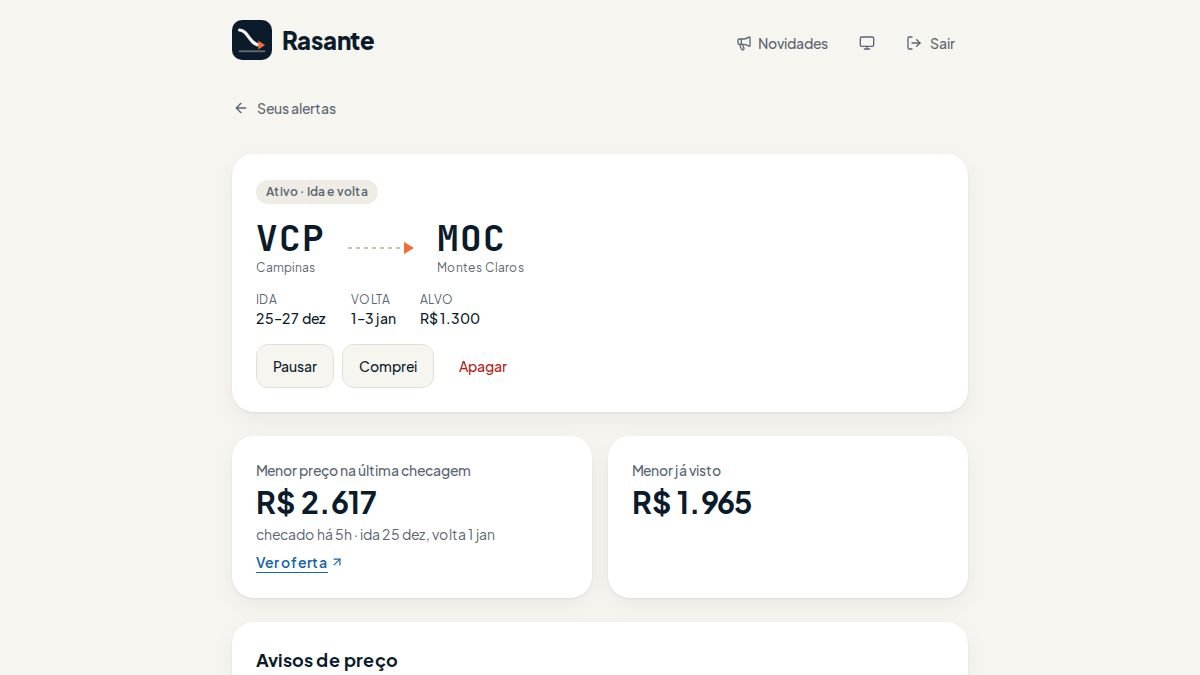
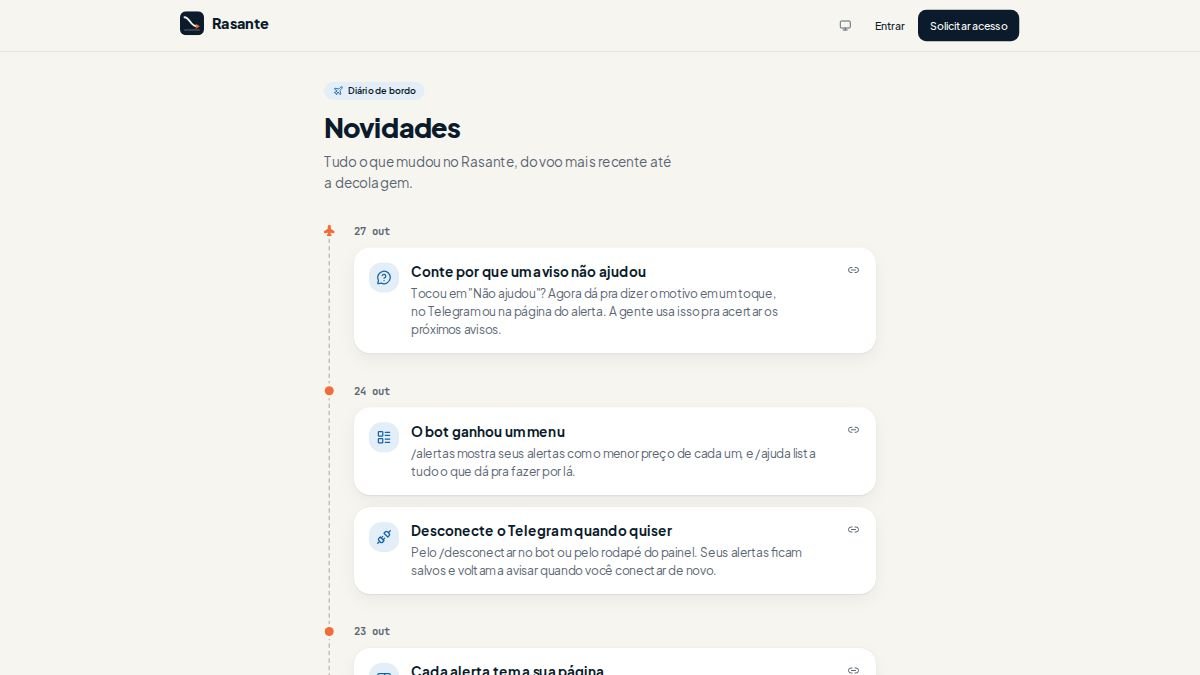
Each alert has buttons to say whether it helped (and why not, when it did not), pause the alert and mark that you bought. The website shows the same alerts and the same actions, along with each alert's history.
I built all of it on my own: the product, the website, the price checks, the database, the bot and the server. Rasante is in closed beta, by invitation and free.
Technical decisions
Query every source and compare only the ones that answered. The first version tried one source and moved to the next only if it failed. The same day I switched to querying all of them and merging the results: for the same flight, a search engine, an online travel agency and the airline's own site show different prices. The cost is collection time, which is now the bottleneck (see What's next). Several sources bring another problem: sources fail, through blocking, a page that changed or an empty response. If a source drops out of one check and comes back in the next, comparing the overall lowest price produces a drop alert and then a rise alert without the price having changed. So the change is computed only over sources that answered in both checks, and a new-low alert requires a minimum difference, as a percentage or in reais.
The database enforces the rules. Supabase with Row Level Security: each user can only read their own alerts, and Postgres checks it with that user's token. The limits on active alerts and date combinations live in a trigger, and grants are per column: the browser can only write the form fields. Deleting an alert is a soft delete, and usage events are written by triggers, so no new screen can forget to record them. Every schema change gets a SQL test that runs against a local Postgres.
Telegram as the alert channel. The Bot API is free, the notification reaches the phone right away and I did not have to publish an app. Messages support formatting and buttons, and the bot edits its own message after a tap: the alert swaps the rating buttons for the "Didn't help" reasons without sending a new message. WhatsApp is the most used messenger in Brazil, but its official API charges for every message sent outside an open conversation, which is exactly what a price alert is. The cost of this choice is leaving out people who do not use Telegram (see What's next).
Same logic for the bot and the website. Rating an alert, marking a purchase, pausing, disconnecting Telegram: the bot's webhook and the website's actions call the same server module. Each event records the channel, so the two can be compared.
Python for the price checks, with tests on the alert rules. The price checks are a Python job. Google Flights, the source that brings the most offers among the ones Rasante checks, has no public API, and the library that builds the query for it is in Python. Python is not my main language: I wrote this part with AI help and only trusted the code once the rules that decide when to send an alert were covered by tests. There are over 130 tests today. Playwright, with headless Chromium, is used only for sources where there is no other way to read the price.
Own server, zero cost. A collection run takes tens of minutes and opens browsers, which does not fit in a serverless function's time limit. Collection started on GitHub Actions and moved to a VPS when Rasante became multi-user. Today it runs on an ARM VM in Oracle's free tier: cron for the price checks, the Next.js site as a systemd service and Caddy handling HTTPS. The monthly cost is zero. In exchange, I run the server myself.
Operations through Telegram itself. There is no admin dashboard. Every call to a source becomes a row in the database with a status (success, empty, error, quota exhausted). When a source changes state, for example from healthy to down, an alert reaches my chat, only on the transition, so it does not become noise. Every Monday a weekly summary arrives, compared with the week before: the funnel from access request to alert click, alerts by type, error rate and p95 per source, the longest run, database size and indexes that were never used. User feedback arrives in a daily summary, and reported problems arrive right away. While the beta has open slots, people who request access get the invitation right away: the database reserves the slot in the same transaction as the request, and if the email fails, the slot is released. With no slots left, the request goes into a queue and reaches my chat with a button to approve it and the server's current headroom, so I let more people in knowing whether there is room.
End-to-end tests without touching production. A script starts local Supabase, the website, the price-check job, a fake Telegram and a fake price source read from a JSON file. The whole story (create the alert, connect Telegram, receive the alert, tap the buttons) runs in about a minute, and the script refuses to start if it points at production.
What I measured
From Oct 23 to Nov 17, 2026, since the multi-user beta went live:
- About 4,900 queries to price sources.
- 165 alerts sent, 88 of them for a drop or a target price reached.
- Median drop of 12% in drop alerts.
- Largest drop in reais: from R$ 4,475 to R$ 3,268, R$ 1,207 less (27%).
- Largest drop in percentage: 29.5%, from R$ 3,710 to R$ 2,617, the alert in the first image above.
- 52 clicks on "View offer".
The test search from the start: 12 departure dates for the same route, from R$ 509 to R$ 1,887. The most expensive date cost about 3.7 times the cheapest.
What I learned
A dependency without a version cap breaks without warning. The library that queries Google Flights released a new major version with a different API. The dependency file had no upper bound, and the main price source stopped working on a fresh install. Now the version is capped, and every source has a health alert that reaches my Telegram when it starts failing.
Scraped prices go wrong in subtle ways. One aggregator mixed sponsored cards and multi-airline combinations in with the search results, and some alerts went out with a price that did not exist on the page. I switched to reading only the result cards and skipping sponsored ones. The "Didn't help" button gained the reason "Price on the site was different", which reaches my chat right away: users see the error before any log does.
Data that was not recorded does not come back. Usage events (creating an alert, clicking an alert, rating, buying) went in before any metrics screen. The numbers above exist only because recording started on the first day of the beta, before I knew what I would ask of them.
What's next
The beta exists to decide whether Rasante continues. In January 2027, once the year-end trip alerts have ended and the "I bought" answers are in, I will decide between opening it to the public, keeping it invite-only or keeping it as a personal tool.
"Is this price good?" To know whether a price is good, you need to know what is normal on the route, and that only comes with time. So since Oct 26 a separate collector has been recording prices on 22 of the busiest routes from Brazil, chosen from ANAC's open data, with no one asking for alerts on them. There are 2,633 samples so far. When the "below normal" badge ships, those routes will have a reference from day one.
Parallel collection. Everything runs in series today, and each alert adds about 7.5 minutes to the run, mostly waiting on pages opened in a browser. CPU stays below 45% during the run, so the bottleneck is waiting, and a bigger machine would not help. The plan is to parallelize with a cap per source and consider a queue with workers only when one server is not enough.
Email and Web Push alerts. Today alerts only arrive through Telegram, which leaves out people who do not use it.
The beta is open to access requests at rasante.app.br.